Executive Summary
- Who this is for: CTOs, founders, Enterprise Architects, technology leaders scaling systems
- Problem it solves: Applying enterprise architecture too early or startup architecture too late
- Key outcome: A clear evolution model for architecture maturity from startup to enterprise
- Time to implement clarity: 30–60 days
- Business impact: Reduced architectural overengineering, faster scaling, controlled governance
The Hidden Problem in Architecture Conversations
Most architecture discussions ignore organizational maturity.
Startup teams are told to adopt enterprise governance.
Enterprise organizations try to behave like startups.
Both approaches fail.
Architecture is not static.
It evolves with the scale of the organization, the complexity of systems, and the level of operational risk.
A startup does not need architecture governance boards.
An enterprise cannot operate without them.
Understanding when architecture must evolve is critical.
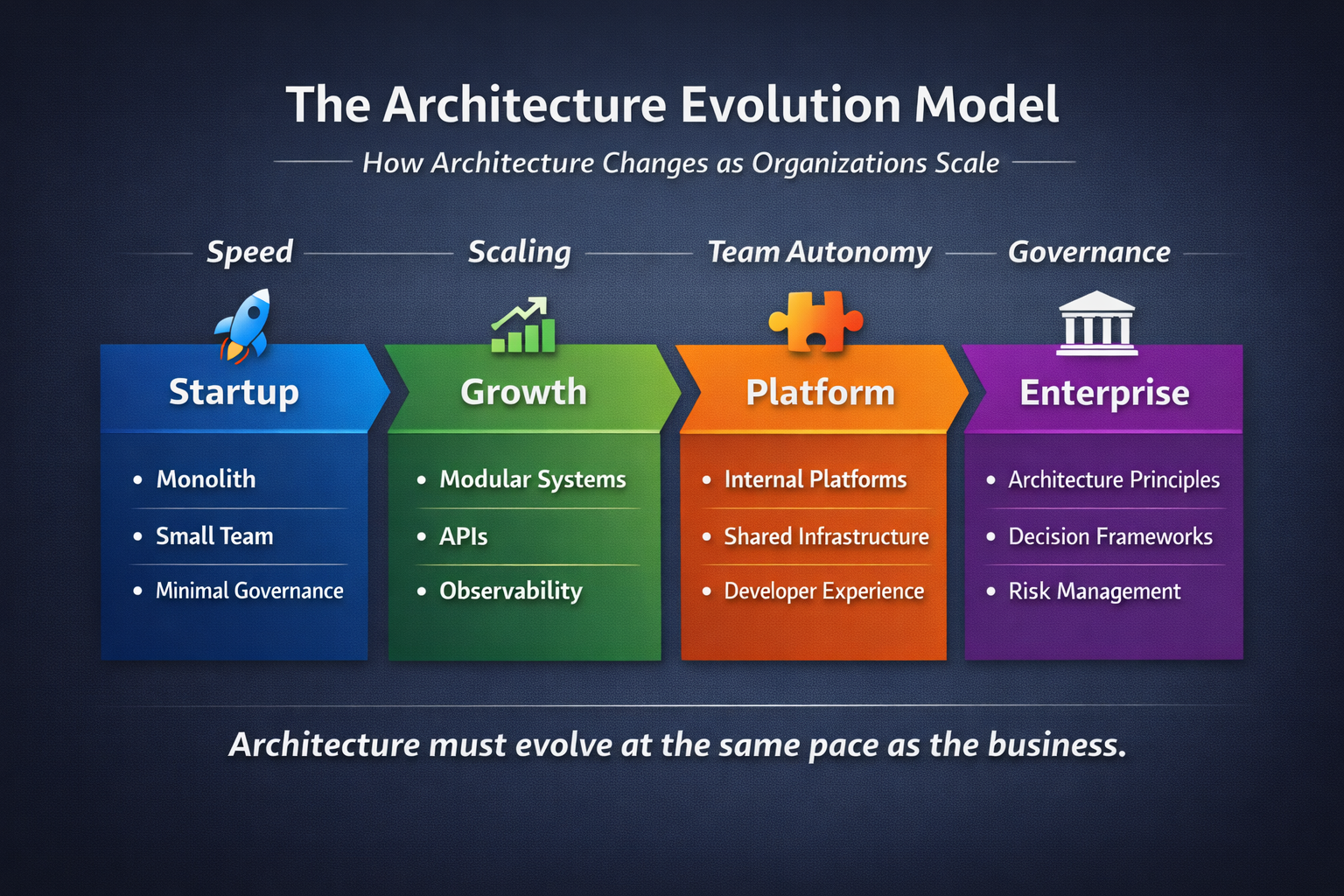
The Architecture Evolution Model
Architecture maturity typically progresses through four stages:
- Startup Architecture
- Growth Architecture
- Platform Architecture
- Enterprise Architecture
Each stage introduces:
- greater scale
- greater system complexity
- greater governance requirements
The mistake many organizations make is jumping to the final stage too early.
1. Startup Architecture — Speed Over Structure
Build something that works.
Characteristics
Startup architecture focuses on speed and learning.
Typical traits:
- Monolithic applications
- Simple infrastructure
- Minimal governance
- Rapid experimentation
- Few architectural constraints
- Small engineering teams
Decisions prioritize time-to-market over structural perfection.
The goal is not architectural elegance.
The goal is validated product-market fit.
Example
A startup building a SaaS platform might begin with:
- Single backend service
- Single database
- Cloud deployment
- Simple CI/CD pipeline
This is entirely appropriate.
Overengineering at this stage slows innovation.
Risk of Failure
If architecture becomes too complex too early:
- delivery slows
- teams overdesign
- resources are wasted
Startups fail more often from lack of speed than from architectural flaws.
2. Growth Architecture — Managing Increasing Complexity
Core Objective
Scale product capabilities without losing development velocity.
What Changes
Growth introduces:
- larger engineering teams
- multiple product features
- increasing user load
- more integrations
Architecture must begin introducing structure.
Typical changes include:
- modularizing the monolith
- separating services
- introducing API layers
- improving CI/CD pipelines
- establishing observability practices
The focus becomes maintainable growth.
Architectural Priorities
At this stage teams introduce:
- service boundaries
- domain ownership
- reliability practices
- performance monitoring
Architecture begins to shape the system's evolution path.
Risk of Failure
If architecture does not evolve during growth:
- the monolith becomes fragile
- development slows
- deployment risk increases
- scaling becomes difficult
Technical debt begins accumulating quickly.
3. Platform Architecture — Enabling Organizational Scale
Core Objective
Support multiple teams building and operating systems at scale.
What Changes
The organization now has:
- multiple engineering teams
- multiple systems
- multiple products
- increasing operational risk
Architecture must introduce platform thinking.
Typical platform elements include:
- shared infrastructure platforms
- internal developer platforms
- standardized deployment pipelines
- shared data platforms
- reusable service frameworks
The goal becomes team autonomy with structural consistency.
Architectural Focus
Architecture now emphasizes:
- standardization
- developer productivity
- platform reuse
- operational reliability
This is where organizations introduce platform teams.
Architecture becomes a product for internal teams.
Risk of Failure
Without platform architecture:
- teams reinvent infrastructure
- operational complexity explodes
- deployment pipelines diverge
- reliability becomes inconsistent
Scaling the organization becomes harder than scaling the system.
4. Enterprise Architecture — Governing Complexity and Risk
Core Objective
Ensure long-term structural stability across the organization.
What Changes
At enterprise scale:
- dozens or hundreds of systems exist
- regulatory exposure increases
- platform investments become strategic
- cross-domain integration becomes critical
Architecture must introduce governance and decision discipline.
Typical practices include:
- enterprise architecture principles
- architecture review boards
- platform strategy
- capability mapping
- architecture decision records (ADR)
- governance frameworks
Architecture now protects organizational stability.
Architectural Responsibilities
Enterprise architecture focuses on:
- technology strategy
- platform consolidation
- risk management
- investment alignment
- structural governance
This layer defines the technology environment in which all solutions operate.
Risk of Failure
If enterprise architecture is absent:
- duplicate platforms emerge
- integration complexity explodes
- governance becomes inconsistent
- technology investments fragment
Large organizations collapse under uncontrolled complexity.
Architecture Evolution Comparison
| Stage | Primary Goal | Architectural Style | Governance Level |
|---|---|---|---|
| Startup | Speed & learning | Simple monolith | Minimal |
| Growth | Manage complexity | Modular systems | Light |
| Platform | Enable multiple teams | Shared platforms | Moderate |
| Enterprise | Govern large-scale systems | Structured architecture | Formal |
Architecture must evolve as scale increases.
What works at one stage becomes dangerous at another.
Why Organizations Struggle With Architecture Evolution
Three patterns appear repeatedly.
1. Enterprise Architecture Too Early
Startups adopt:
- architecture review boards
- strict governance
- complex frameworks
This slows innovation.
Speed disappears.
2. Startup Architecture Too Late
Large organizations keep:
- fragile monoliths
- inconsistent infrastructure
- duplicated systems
Complexity becomes unmanageable.
3. No Structural Transition
Organizations grow quickly but architecture does not evolve.
Technical debt accumulates until a massive modernization effort becomes unavoidable.
Implementation Guide (60 Days)
Phase 1: Assess Architecture Maturity (Weeks 1–3)
Evaluate:
- organizational scale
- system complexity
- governance mechanisms
- platform capabilities
Identify which architecture stage best describes your organization.
Phase 2: Align Architecture to Organizational Scale (Weeks 4–8)
If your organization is growing:
- introduce modular architecture
- invest in platform capabilities
- establish clear architecture principles
- introduce architecture decision records
Ensure governance grows only when complexity requires it.
Evidence from Practice
Organizations that evolve architecture gradually experience:
- stable growth
- faster scaling
- predictable operational performance
- lower modernization costs
Organizations that ignore architectural evolution experience:
- scaling crises
- unstable systems
- massive refactoring efforts
- organizational friction
Architecture maturity must grow with organizational maturity.
Action Plan
Ask three simple questions:
- Which architectural stage does our organization currently operate in?
- Are we applying governance appropriate for that stage?
- What architectural capabilities must we introduce next?
If the answers are unclear,
architecture maturity may already be lagging behind organizational growth.
Final Thought
Architecture is not a fixed blueprint.
It is a system that evolves with the organization.
Startups need speed.
Growing companies need structure.
Scaling organizations need platforms.
Enterprises need governance.
The challenge is not designing the perfect architecture.
The challenge is evolving architecture at the same pace as the business.
Align Architecture Maturity with Organizational Scale
If startup practices are still guiding enterprise systems…
if governance appears before complexity exists…
or if scaling teams struggle with architectural inconsistency —
architecture maturity may be misaligned with organizational growth.
In a focused 30-minute Architecture Maturity Diagnostic, we will:
- Identify which architectural stage your organization currently operates in
- Evaluate whether governance and platform capabilities match system complexity
- Detect structural risks caused by architectural misalignment
- Define the next architectural evolution step
No unnecessary frameworks.
No architecture theater.
No overengineering.
Just architecture aligned to organizational scale.
→ Book an Architecture Strategy Session
or
Architecture maturity must grow with business maturity.